ON a warm late summer evening, with cicadas humming and the day’s heat still in the air, something remarkable will unfold above Australia.
On Tuesday night, 3 March, the Moon will begin to change.
Slowly. Quietly. And then it will turn red.
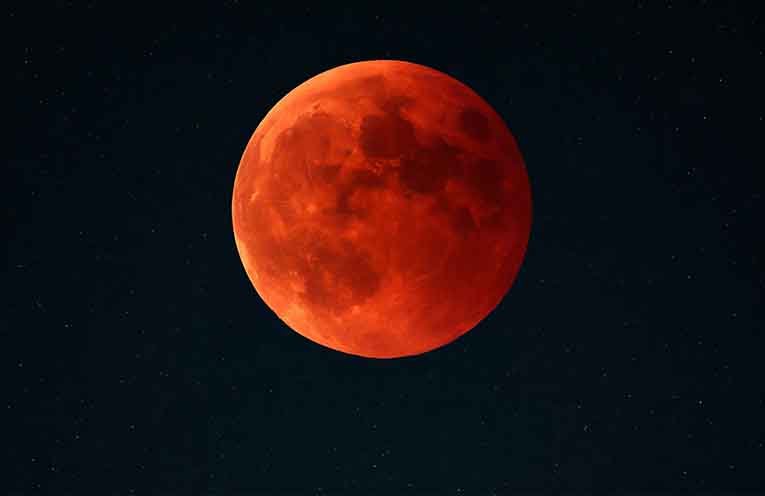
This will be a total lunar eclipse – a blood moon.
For just under an hour, the familiar silver Moon will glow copper and crimson, hanging in the eastern to south-eastern sky like a burning ember.
From Perth’s beaches to Hobart’s waterfront and across inland New South Wales, the whole country will be able to step outside and witness the same transformed Moon.
In New South Wales, the partial eclipse begins at 8:50pm.
A dark curve appears on one edge, as though a careful bite has been taken.
The shadow grows steadily with totality at 10:33pm and the colour reaches its richest glow.
It’s all over by 11pm.
The Mid North Coast Astronomy group led by astronomer Dave Reneke will be at Rocks Ferry Reserve in Wauchope for a free public viewing.
Dave said the Hastings region is perfectly placed to enjoy the spectacle.
“With open skies, coastal horizons and less glare than the big cities, viewing conditions are ideal,” he said.
So, what causes the red light?
“A lunar eclipse occurs when Earth moves directly between the Sun and the Moon, casting a long shadow into space,” Dave said.
“The Moon passes into that shadow, yet it does not vanish.
“Sunlight bends as it travels through Earth’s atmosphere.
“Blue light scatters away, while red and orange light continue on, curving into the shadow and softly lighting the Moon.
“In effect, every sunrise and sunset around the world is projected onto the lunar surface at once.”
The exact colour depends on conditions in our atmosphere.
After major bushfires or volcanic eruptions, the Moon can look darker and deeper red.
In clearer years it may glow orange or copper.
“Each eclipse has its own character,” Dave said.
For ancient cultures, a red Moon demanded explanation.
“Many believed something was attacking it,” Dave said.
“Others saw it as a warning or a sign of change.
“Aboriginal and Torres Strait Islander sky traditions link the Moon to life cycles and powerful relationships between Earth and sky.
“An eclipse could represent a meeting of the Sun and Moon – a moment of meaning and respect.”
While modern science has explained the phenomenon, and we can predict the event to the minute, the sense of awe remains.
“The Moon is our constant companion,” Dave said.
“When it changes colour, even briefly, the world feels different.”
To view the eclipse on Tuesday, Dave says no specialist equipment or telescope is required.
“Simply face east to south-east with a clear view of the sky.
“Arrive early and watch the shadow grow. Binoculars will reveal subtle shading and the curved edge of Earth’s shadow.
“Photographers should use a tripod, as the Moon will be dimmer than usual.”