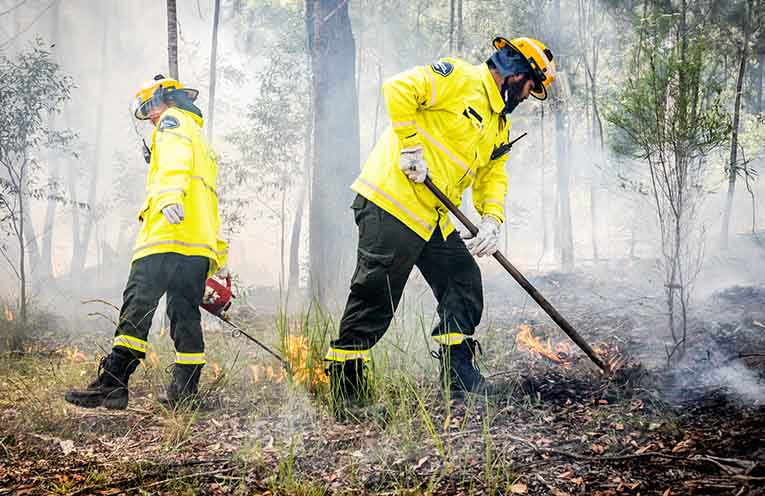
BUNYAH Local Aboriginal Land Council (LALC) community firefighters carried out a cultural burn in Cowarra State Forest on Wednesday, marking the return of traditional Aboriginal fire practices to State Forest management.
The burn brought together 15 community members, Elders, knowledge holders and young people, working alongside Forestry Corporation fire crews, to apply traditional fire knowledge passed down through the generations.

Amos Donovan, local Biripi man and Chief Executive Officer of Bunyah Local Aboriginal Land Council, led the cultural burn in Cowarra State Forest in partnership with Forestry Corporation.
The Cowarra State Forest burn forms part of the “Fire, Country and People: Aboriginal Community Disaster Ready Partnership Project” – a three-year, $2.96 million initiative funded under the Australian Government’s Disaster Ready Fund with $1.48 million provided by the Australian Government and $1.48 million from the Forestry Corporation of NSW.
Forestry Corporation’s Aboriginal Heritage and Partnerships Manager, John Shipp said cultural burning plays an important role in caring for Country and building long-term community resilience.
“Cultural burning aims to apply fire to the landscape in the right place, at the right time and under the right conditions,” Mr Shipp said.
“Fire is applied at a scale that thins out mid‑storey plants, without burning broad areas all at once as we see in high intensity bushfires.
“Burns are carried out when conditions allow for a low intensity, slow‑moving and cool fire, allowing people and animals to move safely away from the flames, minimising harm to the forest canopy and maintaining healthy landscapes.”
“The landscape can’t be too damp or too dry, and the burn may be deliberately patchy with some areas left unburnt to provide shelter and habitat for fauna.
“Burns are timed for when Country may trend toward being unwell if it is not treated through the re-introduction of traditional fire,” he said.
Ecological benefits of cultural burning include reducing heavy fuel loads, opening the forest understorey, promoting grass growth and encouraging the return of native plants and animals not seen on Country for many years.
Traditional lighting methods are commonly used, including hand lighting with matches or traditional firesticks, particularly in open grassy forest types along ridges and mid‑slopes.
The Fire, Country and People project has been co‑designed with Aboriginal communities, including the Bunyah LALC, to ensure community aspirations for cultural burning, disaster readiness and land stewardship are central to all activities.
Burn plans are prepared under Reviews of Environmental Factors or the Bushfire Assessment Code, with cultural context and knowledge added by each community.
Cultural burn sites are prioritised with communities often along traditional pathways based on proximity to fire‑affected communities, public infrastructure, important cultural locations and existing protection zones.
A formal research program is being established to build an evidence base for traditional Aboriginal fire management and its influence on the intensity and extent of bushfires.
Photographic monitoring will be used to track changes in forest condition over time.
More than 60 Aboriginal people across the north coast have already received accredited fire training through the program, with dedicated cultural burning contracts negotiated with Aboriginal partner organisations to support employment and economic participation.
Members of the Bunyah LALC Community have committed to returning to Cowarra State Forest on a seasonal basis to continue treating Country through ongoing cultural burning, ensuring the practice remains a living cultural tradition and an ongoing land management responsibility.