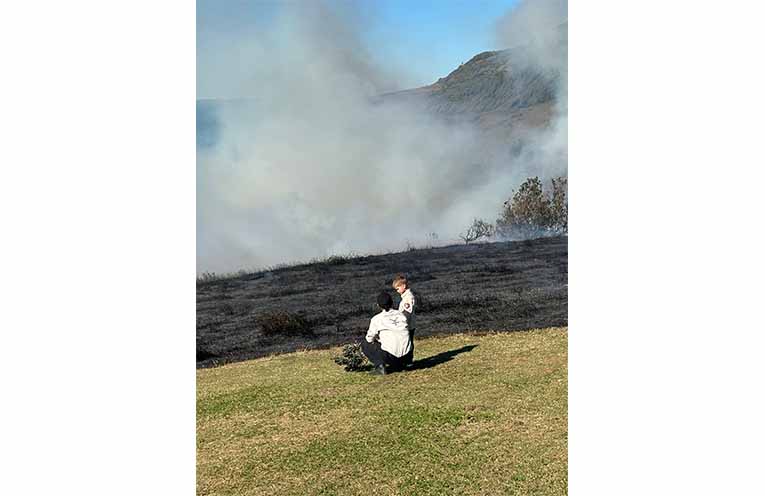
THE cultural burning on Gumbaynggirr Country at Scotts Head Reserve, conducted by the Yurruungga Aboriginal Corporation and Rural Fire Service earlier this week, had little to do with preparing for bushfire season.
“We haven’t seen this area burnt in a long time,” said Yurruungga Aboriginal Corporation CEO Dean Kelly.
“[T]o put fire back on Country is not just about nurturing the biodiversity and ecosystem.
“It’s about honouring our cultural connections.”
Mr Kelly said that cultural burning provided traditional benefits to Country, with modern benefits.
“We are not just burning; it allows us to connect with Country and release stress with our self and emotionally detach from other things that are going on in our world,” he said.
Mr Kelly said Scotts Head was a very significant area to its First Nations people as it provided a connection to their Creation stories.
“During the cultural exchange, we are burning along our songlines, which starts at Guyra at Wattle Ridge, and we are finishing at Scotts Head, where our Creation story comes in.”
The event was the first demonstration cultural burn at a Crown reserve managed by Reflections Holidays – a Category One Crown land manager and the largest holiday park group in NSW.
It formed part of Reflections’ second Reconciliation Action Plan (RAP), which outlines the organisation’s commitment to building opportunities to heal Country within the Crown land reserves in its care with Traditional Owners.
Reflections CEO Nick Baker said the organisation operated on 12 First Nations and the first cultural burn on Country at Scotts Head was significant as Reflections sought to take meaningful action toward reconciliation.
“Reflections manages 40 holiday parks and cares for 45 public reserves spanning more than 10,000 hectares and as a Crown Land manager we regularly partner with Aboriginal and Torres Strait Islander peoples to share and celebrate their culture with our guests to build awareness and respect that moves us towards our vision for reconciliation,” Mr Baker said.
Mr Kelly said the cultural burning honoured traditions that were thousands of years old, and at Scotts Head were connected to the Creation story of the Dungiirr brothers, or the Koala Brothers, touching upon nearby mountain ranges, seas, headland, and area inland.
“The cultural burn is more than just about putting in fire on Country; it’s a combined method of cool burning methodologies and indigenous traditional ecological knowledge.
“By using these knowledge systems of Traditional Owners, we can use fire to help revitalise and rejuvenate Country types at appropriate times via appropriate use of fire,” Mr Kelly said.
Mr Baker said that Reflections’ second Reconciliation Action Plan committed to identify and seek to partner with Traditional Custodians to develop plans to protect and manage Country within the Reflections reserves.
“[W]e are seeing this take place at Scotts Head, thanks to the hard work of our Aboriginal Engagement Officer, our staff, and the Yurruungga Aboriginal Corporation,” Mr Baker said
Mr Kelly said the Scotts Head cultural burning was ‘significant’ and it was the first time the community would be able to watch proceedings.
He said the Yurruungga Aboriginal Corporation was grateful for the support of partners, including Reflections Holidays, the NSW RFS, and Nambucca Shire Council.
Reflections’ Mr Baker said the Scotts Head cultural burn would inform future cultural burns in some of Reflections’ other parks across NSW.
“Reflections will continue to support Aboriginal-owned and led organisations to deliver programs on Country that will nurture the skills of Reflections staff in traditional land management practices,” he said.
By Eve NESMITH